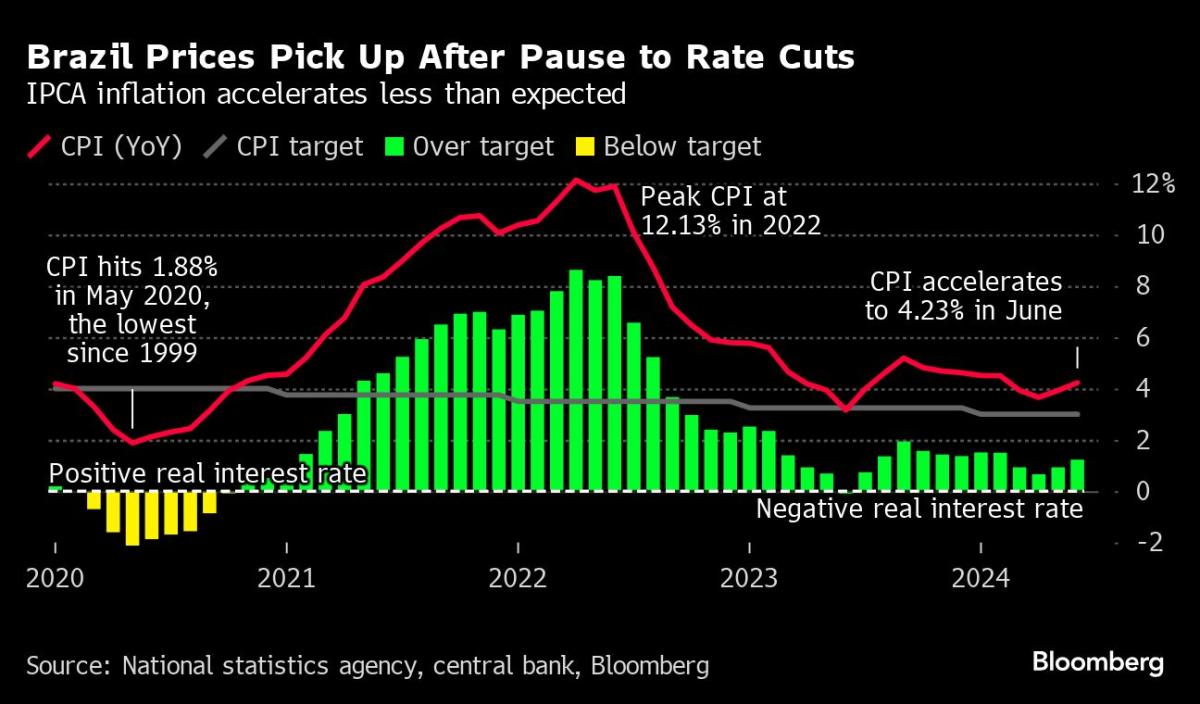
(Bloomberg) — Brazil’s annual inflation rate rose less than expected in June, boosting the central bank after it came under fire for halting interest rate cuts to combat mounting price pressures.
Most Read in Bloomberg
Official data released Wednesday showed prices rising 4.23% from a year earlier, below the median estimate of 4.32% from analysts in a Bloomberg survey. Inflation came in at 0.21% this month, below all forecasts.
Swap rates for the contract due in January 2026, which measure market sentiment toward monetary policy late next year, fell 16 basis points in morning trade after slower-than-expected inflation data was released.
“It was quite an important inflation report,” said Laiz Carvalho, a Brazilian economist at BNP Paribas. “It brings some relief to the central bank.”
Policymakers snapped a nearly yearlong streak of interest-rate cuts last month as the economy beats expectations and investors fret over President Luiz Inacio Lula da Silva’s spending plans. The decision is likely to keep the benchmark Selic in double digits for the foreseeable future, an attempt to quell concerns that inflation will persist.
What Bloomberg Economics Says
“Brazilian inflation surprised in June, but we don’t expect the central bank to budge from its plan to keep the 10.5% interest rate. The print provides some relief from a likely acceleration in coming months and could help discourage rate hike bets.”
— Adriana Dupita, economist from Brazil and Argentina
— Click here to read the full report
Price increases are well below the post-pandemic peak in 2022, but are now being pushed up by higher food costs and a drop in Brazil’s currency, the real. Economists have raised their inflation forecasts even higher than the 3% target.
Food and drink prices rose 0.44% and a 0.54% increase in the cost of personal care products pushed inflation up in June. Meanwhile, transport costs fell 0.19% due to a drop in airfares and lower prices for some fuels, the statistics office said.
Going forward, there are plenty of reasons to be cautious about inflation. While the Brazilian currency has recently trimmed losses, it is still down almost 10% since the beginning of the year. In addition, state-controlled oil company Petroleo Brasileiro SA is raising gasoline prices for the first time in 11 months.
The central bank is independent of the government, and its watchful stance has infuriated Lula. He says borrowing costs are stifling growth and that bank chief Roberto Campos Neto is inflicting too much economic pain by trying to hit an inflation target.
The criticism appears to have resonated with ordinary Brazilians. Lula’s approval rating hit a yearly high of 54% in July, up from 50% in May, a survey by Quaest published Wednesday showed. His disapproval rating fell to 43% from 47%.
The survey also found that 87% of respondents agree with Lula that interest rates are very high, while two-thirds agree with his criticism of the central bank. The survey surveyed 2,000 people nationwide from July 5 to 8, with a margin of error of plus or minus two percentage points.
The institutional conflict has rattled local assets, with markets betting the leftist president will try to exert more political pressure on the central bank when Campos Neto’s term ends later this year.
– With the assistance of Giovanna Serafim, Beatriz Amat and Gabriel Diniz Tavares.
(Adds analysis, details of Lula’s popularity poll and criticism of the central bank starting at paragraph 11.)
Most Read in Bloomberg Businessweek
©2024 Bloomberg LP
#Brazil #inflation #falls #short #forecasts #interest #rates #remain #high