Stay up to date with free updates
Just register Global inflation myFT Digest – delivered straight to your inbox.
In 2022, author, chef and anti-poverty campaigner Jack Monroe sparked an epidemic of mansplaining by suggesting that the cost of UK economy-brand groceries was rising faster than average food prices. The ONS responded by re-ordering its survey, then taking several months to say it saw no problem.
Much of the ONS methodology seemed weak even at the time. And two years later, its central finding seems simply wrong.
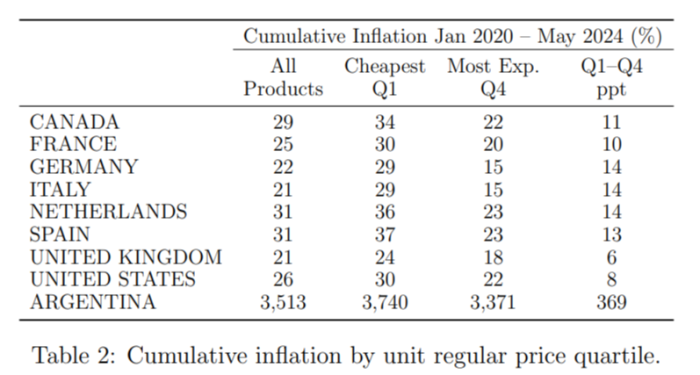
An NBER working paper by Alberto Cavallo and Oleksiy Kryvtsov published last month found “ample evidence” that so-called cheapflation is a global phenomenon. Their study of food prices during the recent inflation surge found that prices of cheap goods rose 1.3 to 1.9 times faster than those of more expensive brands:

Cheapflation was evident in all 10 countries surveyed, the researchers said. Britain had the smallest cheap-to-expensive inflation premium, at 6 percentage points, compared with 14 percentage points in Germany, Italy and the Netherlands:


Cavallo and Kryvtsov’s data set is much broader than the ONS study, which only covers “30 everyday grocery items.” Cavallo is a co-founder of Pricestats, a private data provider, so he was able to obtain unit prices for more than 2.1 million items sold across 91 multichannel retailers between 2018 and 2024.
The huge sample size also allowed researchers to see whether shoppers were able to save money during a given period by choosing products that were on sale that week.
Anyone with time on their hands and no brand loyalty could find savings. Grocery stores pushed through price increases on regular items during the surge, but they maintained aggressive promotions, and discounts had only a small impact on overall inflation:


Such benefits rarely apply to price ranges, which are usually discounted only as they approach their expiration date.
Using data from NielsenIQ Homescan’s Canadian grocery market panel, Cavallo and Kryvtsov estimate that when shoppers took advantage of discounts, they lowered their average unit price by 4.1 percentage points. However, when they switched only to “cheaper” brands—those with lower prices outside of clearance—their average unit price increased by 2.8 percentage points.
None of this should come as a surprise, since cheapflation trends are fairly easy to explain. On the supply side, discount brands are exposed to global supply chains and input prices, without a large margin buffer to absorb rising costs. On the demand side, rising inflation and falling real incomes mean spending is shifting toward cheaper products.
As Cavallo and Kryvtsov write, the economic stimulus introduced during the pandemic, aimed at low-income families, further increased this relative demand:
Ultimately, even if households were able to save money by buying cheaper brands during this period, our results suggest that some of this savings was offset by faster price increases for these brands. Moreover, as overall inflation returned to pre-pandemic levels, the relative prices of cheaper options remained persistently higher, even as inflationary inequality declined. This may help explain why some consumers may feel that prices are “too high”: not only relative to the past, but also relative to more expensive varieties.
The ONS last updated its cheap food index (often called the Vimes ‘shoes’ index) in October 2022. We’ve emailed to check whether the project is still active. We’ve also emailed Jack Monroe, who has retired from public life after making a harassment complaint last June. We’ll update this post if we hear back from either party.
Update (8am UK time, 11 July):
ONS Chief Economist Grant Fitzner told FTAV:
Our previous analysis of a very large number of prices did not reveal a significant difference in price change between the average and cheapest items.
“However, from March next year we are changing the way we work out inflation statistics for groceries, bringing in data directly from supermarkets, which will not only allow us to change prices from a few thousand to several million price points a month, but will also show exactly how much of each item is being bought.
“This means that both the cost and amount spent on each food item will be fully reflected in our figures, reflecting both the impact of retail discounts and changes in consumer preferences within price categories, such as buying cheaper or more expensive items.”
#turns #cheap #inflation #exist