Australia is now in the same league as Lithuania, Estonia and Hungary when it comes to reducing real wages, a new OECD report has found.
These are the only countries where cuts in real wages – i.e. wages adjusted for inflation – were more painful for low-paid workers than for those receiving higher salaries.
Compared with the period immediately preceding the pandemic, real wages are now lower in 16 out of 35 countries, according to the latest OECD Employment Outlook 2024 report.
Real wages in Australia are 4.8% lower than before the pandemic, while across OECD countries real wages have risen by an average of 1.5% over the same period.
How did we get here?
Wages are an artifact of both market and institutional forces. As economist Thomas Piketty has noted, “technology and skill set the boundaries within which most wages must be set,” while institutions like unions and government policy set the wage levels that actually prevail in a given country at a given time.
In recent decades, the institutions that shape wages have been transformed. Employers have much greater bargaining power today than in the era of full-employment capitalism (i.e., the post-war period until the mid-1970s).
Peter Rae/AAP
This is not unique to Australia. The OECD reports that several of the countries we usually compare ourselves to are also struggling with real wage declines.
These include Canada, New Zealand, Norway and Japan. Australia’s path to real wage decline was, however, distinctive. Two profound changes occurred.
Transition to Corporate Negotiations
The first was the move to collective bargaining in the late 1980s and early 1990s. Before this change, Australia had a distinctive system combining collective bargaining and arbitration.
Well-organised trade unions in sectors such as manufacturing, construction, road transport, warehousing and coal mining set standards for the rest of society.
Industrial tribunals then generalized these gains, increasing wage rates for all workers. In short, it was a system in which the wage gains of the strong flowed to the weak.
Corporate bargaining destroyed this system. This meant that wage increases for the powerful were quarantined in the companies where they worked. The rest of the workforce had to fend for themselves.
The very low paid receive some minimum wage protection in the annual pay review aimed at the most vulnerable members of the workforce. But even in this “reformed” system, pay leaders still played a role.
They established social norms that other workers could consider the standard for wage increases. As the number of manual workers decreased and the number of services increased, the nature of wage leaders changed.
A changing workforce
In the 1960s, one in four workers worked in the manufacturing industry, while other, well-organised trade unions accounted for 15% of all employees.
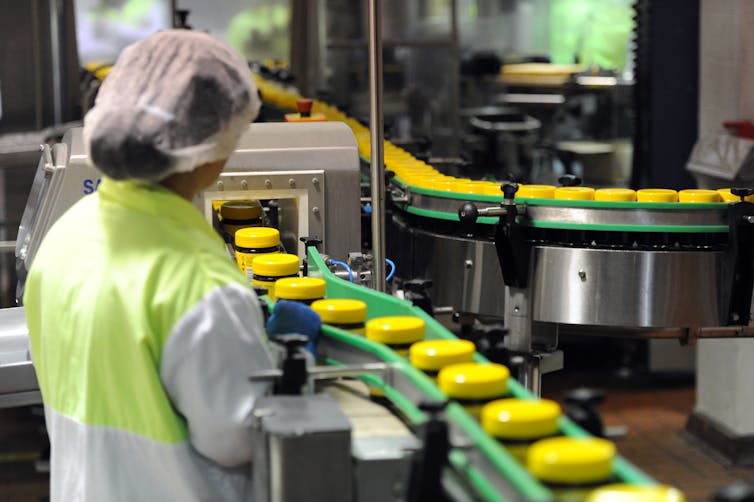
Today, less than 7% of the workforce is employed in industry, and much of the manual work has been replaced by automation or transformed through activities such as outsourcing and hiring.
Julian Smith/AAP
In the late 1990s and early 2000s, new sectors such as education and healthcare began to set trends in pay standards.
Teachers and nurses in states such as New South Wales have set the standard through vigorous campaigning, and related work value cases have won pay rises of 8–10% in nominal terms and 4–5% in real terms.
These standards were then passed on to other public sector workers and society at large in the form of wage rate increase standards.
All this ended in 2012. This was the second important moment of change.
This year, the newly elected O’Farrell Coalition government in New South Wales passed legislation banning annual pay increases of more than 2.5 per cent for state government workers.
This became the norm as all other jurisdictions in Australia followed suit. This limit remained in place until the defeat of the New South Wales coalition government last year.
The cap has been relentless during the post-COVID inflation spike. As a result, real wages for teachers, nurses and other government workers have fallen by more than 10% in the post-COVID era.
What needs to happen to solve Australia’s real wage problem?
In 2023, the new Labor government in New South Wales abolished this cap and public sector pay began to change again.
Last year, the average pay rise for public sector workers in NSW was 4%. Teachers in NSW saw a 10% to 14% increase in their one-year contract. Paramedics gained an average of 8% a year in their three-year contract.
Nurses in Victoria recently agreed to a 28.4% reduction over four years.
Recent changes indicate that the first of the two main factors holding back real wage growth has been addressed. But the wage restraint embedded in our system of enterprise bargaining remains.
Changing our approach
The OECD notes that in countries where real wages have recently been rising, inflationary pressures have been contained as businesses have suffered losses in the form of reduced profits.
Indeed, he notices
the increase in … profits over the past three years provides better protection against inflationary pressures resulting from the recovery in real wages.
It is important that the debate on wage policy moves beyond the exhausted arguments of market economists who fight the battles of the past – obsessed with the fear of a “wage and price” spiral.
In Australia, real wages have been depressed for too long.
We need a mature debate on how to overcome this legacy in a sustainable way. The OECD’s observations on excess profits providing the capacity to absorb future wage increases are an important contribution to the debate.
#real #wages #fallen #Australia #rising #OECD #countries